
Hello,
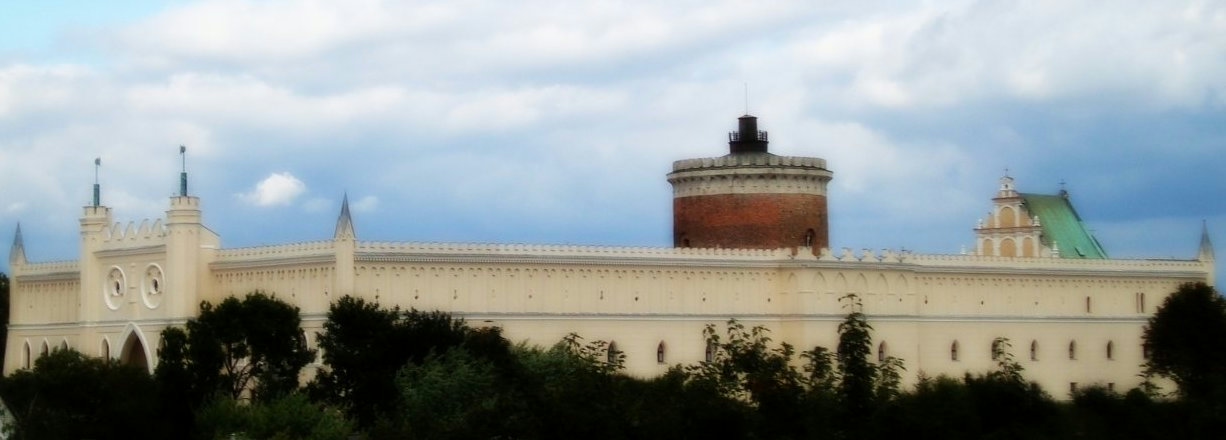
My name is Konrad Wdowiak, and I was born in Poland in 1976, at a time when the communist regime was beginning to lose the support of the Polish people. Eventually, the government imposed Martial Law, closed the borders, and made it nearly impossible to leave the country, nor to enter it, as a matter of fact. Lublin, my hometown, had once been a place where people of different religions and nationalities lived side by side for centuries. Traces of those cultures, of its former burghers, still remain. Under communism, however, they were quietly suppressed, as if those people had never existed. And yet, they were still there: one of my friends went to a different church than I did; another spoke a language with his mother that I couldn’t understand. A tomb near my grandfather’s grave bore inscriptions I couldn’t recognize. As a curious child, I had so many questions Questions my parents, both born during World War II, couldn’t always answer. My grandparents sometimes spoke of their pre-war neighbors and childhood friends, but it all felt like a world long gone.
We couldn’t travel outside of Poland, but at least I could explore within my motherland. And the more I learned about my hometown, the more I realized there was still so much left to discover. In time, communism collapsed, and the borders opened, but travel was still out of reach for many of us, with the Polish currency holding little value abroad. I began my university studies, working towards a master’s degree in Business and Management, and, eager to learn more, I also enrolled in a second program to pursue a master’s in Sociology. That’s when I joined a student program that allowed me to live and work in the United States. I had spent years fascinated by the multicultural past surrounding me, and finally I was becoming a participant in a multicultural present.
I went to live in California, where I spent a year among people from a wide range of cultural backgrounds. By that, I don’t necessarily mean different ethnicities, because that’s where I first learned that even people from the same country, holding the same passport, like in the U.S., can be worlds apart. One of the most important lessons I took away from that time was realizing that cultural differences can be bridged when people are willing to put a shared goal first.
When there’s a will, there’s a way.

I came back from the States with a completely different mindset than the one I’d had before. I wasn’t just changed, I was almost a different person, eager to share my insights with anyone who would listen. But Lublin, even though it’s the largest city in Eastern Poland with strong academic institutions, it still ranks only ninth in size nationally and is surrounded by largely rural, non-industrialized areas (its decline began with the Russian partition in the 19th century, but that’s a story for another post). There, my knowledge and skills felt neither needed nor appreciated. That’s why I decided to move to Kraków, the former medieval capital, Poland’s second most important city, and a place with strong international ties, including many connections to the U.S.
My life in Kraków was pivotal to my professional journey. In addition to working as a university lecturer, I became a trainer specializing in intercultural communication. That’s where I began collaborating with relocation companies to support their clients who were moving to Poland for work and life abroad. I created tailored programs to help them navigate everyday life, build friendships, and find ways to socialize, I became a guide to their new expat experience. I loved my job then, and I still love it now. It gives me the chance to meet a wide variety of people and to learn just as much from them as they do from me.

While living in Kraków, I became actively involved with SIETAR – the Society for Intercultural Education, Training and Research. I didn’t just manage the largest local branch in Poland; I also co-organized the SIETAR Europa Congress in 2011, where I was responsible for the parallel program and social events. That’s when I met lifelong friends, people who remain important to me even now, in 2024, and with whom I’ve collaborated on many projects since including NATO conference titled “Intercultural Competence as a Key Factor to Effective International and Cross-Border Cooperation”, and EURO 2012 Academy (the official intercultural training program of the Polish government for the hospitality industry, aimed at improving communication with tourists attending the UEFA EURO 2012 football championship). It was during that project when I received one of the most memorable compliments of my career: before the second day of training, a 60-year-old participant stood up and said loudly, “We should listen to Konrad—my daughter was in Italy and she says that he is telling the truth”.
It was 2012 – a year of changes. My partner and I were learning Spanish, thinking we might move to Spain someday, but instead, we ended up in London when he was offered a job. That’s when I become a trailing spouse or an accompanying partner like some of us prefer to be called. Although at first it was a love-hate relationship, London is now my home. I understand how difficult it is to move to a new country for the person you love, to leave behind friends and family, and step into the unknown – especially when your partner goes to work and you stay home every day. That’s when I created a special program to support people like me, because these challenges can strain relationships and take a toll on mental and physical health. There’s no need to walk this path alone.

Living in London opened up a whole new world for me, not just because the city is a global hub and one of the world’s greatest capitals, but because being here sparked my curiosity and creativitylike never before. Traveling became a natural part of my life: making friends from all over the world, visiting them in their home countries, enjoying cuisines I never imagined I would try, and working with clients from every corner of the globe. I began exploring cultures far beyond Europe, among others South Korea, Mauritius, Latin America, and naturally, returning to the U.S. on a regular basis which became much easier. All of this enriched my perspective and deepened my understanding of diversity. London became my creative playground for intercultural learning, inspiring me to blend ideas and approaches from around the world and apply them in fresh, innovative ways. This vibrant, multicultural melting pot transformed the way I think, work, and relate to others, fueling both my personal growth and my professional passion for helping people navigate complex cultural landscapes.
Since 2006, I have helped hundreds of people break free from the boundaries of culture. Yes, crossing these barriers truly makes us free because it opens our minds to new ways of thinking. We can only choose the best option when we have many to choose from. Like mixing and matching new ingredients, you can create something unexpected. At the end you may be surprised how tasty the outcome can be!