Many posts on this website focus on travel, as understanding different cultures is central to both my professional interests and personal motivations. That’s why I travel far more often than the average holidaymaker. In fact, I’d love to do it even more. While discovering other people and cultures enriches my perspective, it cannot always be the primary focus, unfortunately. My work is. I specialise in training, coaching, and mentoring individuals on how to communicate effectively across cultures and adapt successfully to life and work abroad. Although the core themes may seem consistent or even repetitive, the diversity of cultural backgrounds among my clients ensures that each session brings new perspectives and challenges, making the work dynamic and highly rewarding. Every single session is unique.
Occasionally, I present my work to larger audiences. Recently, I delivered an introductory session on Poland, my home country, which I believe may offer both a glimpse into Polish culture and a sense of how I approach my work. This article is based on a condensed, one-hour version of a broader programme. Typically, my full-day sessions (around eight hours) cover a range of topics such as working and doing business in a given country, social and everyday life, communication styles, networking, managing culture shock, and navigating the adaptation process. This brief introduction was just a taster.
So, without further ado, here is what I believe everyone should know before visiting, relocating to, or doing business in Poland. To keep it accessible and easy to follow, this Introduction to Poland is divided into two parts; this first section focuses on history, as covering everything at once would simply be too much.
A “brief” history
Poles are deeply invested in history, perhaps because we once held considerable power and influence in Europe. Much of that prominence stemmed from a strategic alliance with our last pagan neighbour, the Grand Duchy of Lithuania (which, at the time, was several times larger than Poland). In 1386, we convinced the Lithuanian Grand Duke to convert to Christianity, marry our 11-year-old king (yes, “king” was an official ruler’s title used regardless of their gender, while “queen” was reserved solely for the king’s wife), and help us fight off the Teutonic Knights. In return, Lithuania gained access to European recognition and was brought under Polish influence, culturally and economically. We basically let the Lithuanians feel European and pay us taxes. It may sound like a one-sided deal, and in many ways it was. That’s also how one of Europe’s longest and most complex love-hate relationships between neighbouring nations began, but more on that shortly.
Whatever some may claim, there were no ancient Poles. The region was first inhabited by Celtic and Germanic tribes, and it wasn’t until later that the first Slavs, our ancestors, arrived and settled permanently. Well, most of us did, some eventually made their way to take over the UK, but since that did not happen for the next 1500 years anyway, we’ll leave it out for now. Why does this matter? Because, as everyone should know, and those who don’t might be better off staying silent, we Poles are rightly proud of two world-class contributions: amber and wódka (yes, wódka, never “vodka”). Since wódka came into prominence only in the 15th century, let’s focus for now on the older treasure: amber.
Baltic amber has long been prized for its exceptional beauty and value, so much so that it was found in the tombs of Egyptian pharaohs, including Tutankhamun. Just as the Chinese had their Silk Road, we had the Amber Road, which was already in use thousands of years ago. Sadly, it’s not technically “ours” in a modern territorial sense, but we still claim it proudly. Much like we claim Biskupin: a late Bronze Age/early Iron Age fortified settlement built in the middle of a lake. For a time, it was thought to be clear evidence of early Slavic presence conveniently located just 30 kilometres (less than 19 miles) from Poland’s first known capital, Gniezno. It’s not as if today’s Greeks are direct descendants of those who worshipped Zeus… but that’s beside the point!
Moving forward to the time when the people who gave Poland its name truly emerged, we arrive in the 9th century AD. This was when the chieftains of the Polans, a West Slavic tribe whose name means “people of the fields”, began consolidating nearby tribes who spoke similar languages under their rule (though “consolidating” may be a generous description of that process). The first historically confirmed ruler of Poland was Mieszko I. In 965, he chose to part ways with his pagan wives and marry a Christian princess from Czechia. This alliance is traditionally credited with bringing culture, Catholicism, enlightenment, and international recognition to the emerging state, or so the official version goes.
Poland began to grow rapidly from that point onward. Mieszko’s son, Bolesław I (known as “the Brave”), became the first pope-crowned king of Poland, introduced the country’s first monetary unit, and significantly expanded its territory, even going so far as to conquer parts of Kievan Rus and install his son-in-law as a puppet ruler. This promising trajectory might have continued uninterrupted were it not for one disastrous decision, ironically made by my namesake, Konrad of Masovia. Nearly 250 years later, he invited the German crusading order known as the Teutonic Knights, officially, the Order of Brothers of the German House of Saint Mary in Jerusalem, to help subdue the pagan Baltic Prussians. Instead of assisting and departing, the Knights established their own powerful state in the region, displacing Polish control and setting their capital in Marienburg (today’s Malbork). Incidentally, the Malbork Castle remains the world’s largest by land area and the largest brick structure ever built.
The united forces of the Crown of the Kingdom of Poland and the Grand Duchy of Lithuania defeated the Teutonic Order in one of the largest battles of medieval Europe, the Battle of Grunwald (known in German as Tannenberg). The Order’s Grand Master, Ulrich von Jungingen, was killed in action, and the victory became a defining moment in Polish history. To this day, nearly every Pole knows the date, 1410, not only because it marks a rare and decisive triumph over German forces, but also (somewhat humorously) because it doubles as the country’s most commonly cited recipe for moonshine: 1 kilogram of sugar, 4 litres of water, and 10 decagrams of yeast. While the latter is more folklore than strategy, the battle remains a powerful symbol of national pride and resistance against foreign domination.

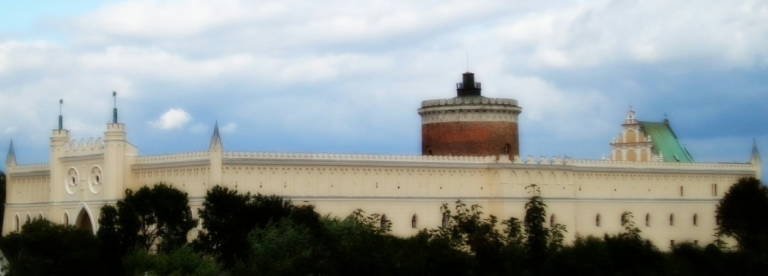
As you can clearly see from the map of Europe in 1444, the Polish–Lithuanian state was the largest political entity on the continent, and it wasn’t even at its peak yet. This period marked the beginning of Poland’s so-called Golden Age. Our royal dynasty had become one of the most influential players in Europe. Eventually, in 1569, in my hometown of Lublin, the Polish and Lithuanian nobility agreed to transform their personal union into a real one, establishing a single state through the Union of Lublin. With the reigning king childless, they also introduced an elective monarchy, an extraordinary political decision for the time. Lublin, located roughly halfway between the two capitals, Kraków and Vilnius, emerged as one of the most important and affluent cities of the Crown, a status still visible in its historical architecture. The political system of the Polish–Lithuanian Commonwealth, often referred to as the Nobles’ Democracy, granted equal legal status to all nobles regardless of wealth, rank, or ethnicity. The Crown became one of the most decentralised, democratic, and religiously tolerant countries in Europe, a nation fundamentally opposed to the idea of absolute monarchy. This remarkable union lasted until 1791, when it was replaced by a unitary state, though, unfortunately, that reform came a bit too late.


We’re nearing the end of today’s post. Why, you may ask, there are still almost 250 years left to cover, after all. True, but they weren’t exactly Poland’s finest years, and for now, we’ll leave most of that history aside. It was on 3rd May 1791 that Poland adopted its new constitution, the second in the world after that of the United States. It was a remarkably progressive document for its time, clearly separating executive, legislative, and judicial powers. Unfortunately, our neighbours were less than enthusiastic. Alarmed by the reforms, they joined forces to dismantle them – by erasing Poland altogether. Prussia, Austria, and Russia annexed large parts of the country in three successive partitions: first in 1772, then in 1793 (without Austria this time), and finally in 1795, when the last remnants were divided among them. Poland disappeared from the map of Europe for 123 years. It wasn’t until the end of World War I, on 11th November 1918, that independence was restored and the Republic of Poland re-emerged. But that’s a story for part two.