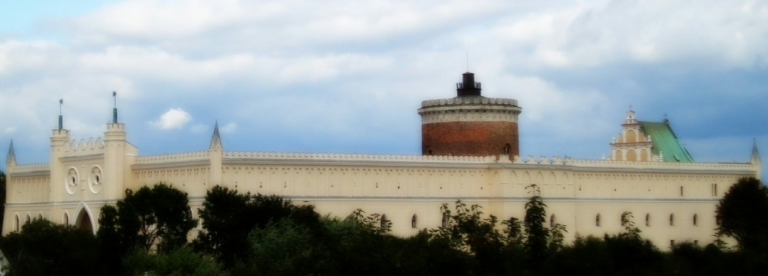
When working with Polish people, it’s almost inevitable that history will come up at some point. We ended the previous post with the partitions of Poland, which lasted for 123 years and had a profound impact on Polish culture. When Poland finally regained independence in 1918, it was no longer the Poland of 1795. Other countries also emerged as independent states, including Lithuania. Vilnius, the historical capital of Lithuania, where, at that time, almost everyone spoke Polish (the language of education and culture, though not necessarily of national identity, suddenly became the capital of the newly formed Lithuanian state. This caused considerable tension, especially in Poland, where many viewed Vilnius as part of the shared heritage. Polish forces eventually moved to reclaim it. To complicate matters further, much of the Polish intellectual and political elite of the time originated from Lithuanian lands and spoke Polish, blurring the lines between language and nationality. The opening line of Poland’s national literary epic “Pan Tadeusz” by Adam Mickiewicz: “O Lithuania, my fatherland…”, perfectly captures this complexity. Mickiewicz, one of Europe’s greatest Romantic poets, embodies a time when national identity was far more fluid than we tend to assume today. Needless to say, a revival of the old Union of Lublin is not on the horizon.

The newly re-emerged Poland was a remarkably diverse country. Around one-third of its population belonged to minority groups, approximately 15% were Ukrainians, over 10% Jewish, with significant numbers of Belarusians, Germans, and others. Roman Catholics made up just over half the population, while the rest included Eastern Catholics, Orthodox Christians, Jews, and various Protestant communities. Religious and linguistic affiliations didn’t necessarily align with personal or national identities. At the time, nationalism was still a relatively new and unevenly embraced concept, especially in rural or borderland regions where identities were often more fluid. In the Polesie region (on the left, roughly around modern-day Brześć, now near the Polish–Belarusian–Ukrainian border), many residents simply identified as tutejsi, meaning “from here.” In the 1931 census, some even listed tutejszy as their native language. They were also far from a homogeneous group, rather, it reflected the complex patchwork of cultures and loyalties that shaped life in the Second Polish Republic.
The citizens of the newly independent Polish state faced the enormous challenge of rebuilding a nation that had, for over a century, been divided between three empires. Although politically unified, the partitions were deeply present in everyday life (as they still are nowadays). Just about every system – legal, educational, administrative, even railway gauges, reflected the influence of the former occupying powers. Cultural norms and personal attitudes differed significantly across regions as well. These regional differences are more than anecdotes; they’re a living legacy of Poland’s complex history. When I train on Polish culture, I often say that Poland is, in many ways, still three countries in one:
- I come from the former Russian partition—I tend to arrive 15 minutes late, and it’s never a problem;
- My husband is from the former Austrian side—he’s also 15 minutes late, but he feels guilty about it;
- And Poles from the former Prussian partition? They’re usually 15 minutes early.
And those regional differences remain visible even today, in 2023. They influence everything from railway and road infrastructure to rural–urban demographics, average income levels, and even voting patterns. Considering how little time the Second Republic had, just over two decades, to unify such a fragmented society under a single legal and administrative system, the effort was extraordinary. Yet, just as Poland was making progress, World War II broke out. First, Germany invaded from the west, and two weeks later, the Soviet Union entered from the east. After nearly six years of brutal occupation and resistance, the war ended with Poland’s borders shifted several hundred kilometres west. Stalin was, as we say in Poland, “generous” with things that weren’t his, he gave us territories that had belonged to Germany while taking away vast eastern lands that had been Polish for centuries. We have a saying about Soviet “generosity” – they took something from us, but we always have to give them something else in exchange – you get the picture.
The result was yet another new state, the People’s Republic of Poland (PRL), an overwhelmingly homogeneous country, with approximately 95% of the population identifying as Polish Roman Catholics. Many were resettled into the newly acquired western territories (marked in red on the map above), areas previously inhabited by Germans who had been displaced. This population shift gave rise to a fourth category of Poles: the settlers, or pioneers. These were people with little or no historical ties to the land, focused more on building a future than preserving a past. Perhaps because of that, they became some of the most cooperative and community-minded citizens in the country, having learned that success in those difficult post-war years required collaboration, not individualism. Simply because there was always more work than one person could handle alone.
Who are the Polish
Even though I mentioned that the partitions are still visible among the Polish, it is possible to group some characteristics which are common for my compatriots. There are these which make us all happy of being who we are, and those which we would wholeheartedly disagree with.


Poles are generally known for their hospitality. Dropping by someone’s home without prior notice is still relatively common, and guests are typically offered something to eat if it’s around mealtime, or at the very least, tea or coffee accompanied by something sweet. If the hosts are unable to provide refreshments, they may feel embarrassed or unprepared, so bringing a small gift or treat is always appreciated. That said, as daily life has become more fast-paced, it’s increasingly advisable to let your hosts know in advance to ensure your visit doesn’t disrupt their plans.
Family and faith remain core values in Polish society, often deeply intertwined. Religious celebrations provide an important opportunity for gathering and spending time together, particularly during Christmas (well, Christmas Eve), Easter, or All Saints’ Day, all of which are observed in traditionally expected ways. While regular attendance at Sunday mass is gradually declining, many Poles still identify strongly as Catholics. Criticism of the late Pope John Paul II, however, remains socially unacceptable, such discussions are best left to Poles themselves. Given the central role of family, practices like nepotism are not always viewed as negatively as they might be elsewhere. On the positive side, once you are accepted as part of a Polish “family,” whether by blood or by bond, the support and loyalty you receive are enduring.
Polish national identity has long been shaped by a history of struggle and resilience. Our heroes are often remembered not for their victories, but for their sacrifice, figures of defiance rather than triumph. This legacy has nurtured a cultural bravado that may appear as bravery, and indeed, we often see it as such. Planning far ahead is not always a priority; history has taught us that circumstances can shift quickly and unpredictably. Deep-rooted mistrust of authority, born from generations of occupation, censorship, and systemic manipulation, has made “creative” problem-solving a valued skill. One might also call it adaptability, and for many Poles, it has been a necessary path to survival.


If you want to build rapport with Poles, start with our history, we’re deeply proud of it, and yes, perhaps a little obsessed. A “carrot-and-stick” approach rarely works here; we tend to be fiercely independent and will often resist even beneficial outcomes if they seem imposed with the wrong attitude or if others appear to gain more than we do. It’s a trait not unlike the proverbial “dog in the manger,” and we’re the first to admit it. That said, one guaranteed way to win our hearts is by attempting to speak our language. Even a few words, especially if accompanied by a sincere comment about how notoriously difficult Polish is, can create instant goodwill. We’ll likely admire your effort and will love you till death do us part!.
I’d like to conclude this section with a brief comparison using Hofstede’s cultural dimensions model. While the model has its limitations, I find it useful as a framework to illustrate cultural contrasts in a simple and accessible way. It can be particularly helpful when adjusting one’s behaviour in a new cultural context. If you’re interested in exploring it further, I recommend using Hofstede’s country comparison tool for more detailed insights. For the purpose of this article, I’ll focus on just three dimensions and, since many of my clients and readers are from the United States or the United Kingdom, I’ve chosen to compare Poland with these two countries.

The first dimension is Power Distance. Unlike the United States and the United Kingdom, Poland has a noticeably hierarchical society. If you are the boss, people generally won’t tell you directly what they think. Fraternising with subordinates is usually frowned upon, they may see it as a sign of weakness. In contrast, Poland is less individualistic than the US or UK. We tend to work well as a team, and collective effort is valued more than one might expect, though not to the extent seen in many East Asian cultures. Finally, Poland scores very high on Uncertainty Avoidance. Change is often viewed with suspicion or even fear. To feel secure, we create rules and we love having them (following? not so much!). The British common sense? Forget about it!
The Hofstede model is naturally much more complex than these few sentences suggest, and some aspects may even seem contradictory to what I’ve mentioned earlier. You can follow the link to explore the subject in more depth on your own or consider scheduling a session with me to learn how to work and live effectively among the Polish. Keep in mind, this post is not intended to replace a full learning session.
Good luck with your Polish adventure! Oh, and don’t thank me, please. In our culture, that would jinx everything and cancel out the wishes. Instead, you can always say: “I do not thank you!” Everyone will understand.